Aug 13, 2026
Full Body Workouts: Why Pilates (and Puppies) Does It All
Discover how Pilates delivers a complete full body workout for all fitness levels, and why doing it with puppies makes it even more effective.
Picture this: you roll out your mat, your dog immediately flops down on it, and somehow you both end up doing stretches together. Sound familiar? Whether you have a furry workout buddy or you're flying solo, one thing is clear: finding a full body workout that actually feels good can be a total game changer, especially when you're just starting out.
Here's the thing about Pilates. It checks every single box when it comes to working your whole body without leaving you completely wrecked the next morning. It strengthens, stretches, and builds core stability all in one session, making it one of the smartest choices for beginners who want real results without the overwhelm.
In this post, we're breaking down exactly why Pilates is the ultimate full body workout for newcomers. You'll discover the key benefits, what muscle groups it targets, and a few beginner-friendly moves to get you started. Plus, we're throwing in some puppy inspiration along the way, because honestly, dogs have been doing yoga poses forever and they deserve some credit.
What Actually Makes a Workout 'Full Body'?
A full body workout is exactly what it sounds like: a single session that works all your major muscle groups, including your core, glutes, back, chest, arms, and legs, rather than saving each group for its own dedicated day. Think of it as the difference between covering the whole map in one trip versus making separate journeys to each destination. According to peer-reviewed research comparing split and full body training, full body routines deliver meaningful strength and hypertrophy gains, making them a genuinely effective approach, not just a beginner shortcut.
If you're new to working out, this format is your best friend. Split routines, like "leg day" on Monday, push exercises on Wednesday, and pull movements on Friday, only work if you actually show up for every single session. Miss one day and an entire muscle group sits untouched for the whole week. Full body training removes that pressure entirely, since every session covers your bases whether you make it to class twice a week or three times.
The ACSM's top fitness trends for 2026 highlight accessibility and hyper-personalization as the industry's defining priorities, reflecting a clear shift away from rigid programs designed only for dedicated athletes. Fitness is finally evolving to meet real people with real schedules.
That's exactly where Pilates steps in. It hits every major muscle group through controlled, intentional movement, delivers genuine full body conditioning in a single low-impact session, and fits perfectly into a busy, unpredictable week. It checks every box.
Every Muscle Group Pilates Actually Works
One of the biggest surprises for Pilates beginners is just how much the method actually covers. Let's break it down muscle group by muscle group.
1. Core: Way Deeper Than a Six-Pack
When people think "core workout," they usually picture crunches. Pilates goes much further than that. Every single exercise is built around activating your deep core muscles, specifically the transverse abdominis (think of it as your body's natural corset), the obliques on the sides of your torso, and even your pelvic floor. These are the stabilizing muscles that hold your spine safe during everyday movements like picking up a grocery bag or sitting at a desk for hours. Surface-level abs are just the icing on the cake.
2. Glutes and Legs: Surprisingly Intense
Don't let the gentle reputation fool you. Moves like bridges, leg circles, and the standing side series will have your glutes and hamstrings talking to you the next morning. These exercises take your hips and legs through a full range of motion in a slow, deliberate way that fires up the glutes, quads, hamstrings, and hip abductors all at once. Controlled movement means there's no momentum helping you cheat through the hard parts.
3. Back: Built-In Posture Correction
Pilates pays serious attention to the back, both upper and lower. Through spinal articulation, extension exercises, and scapular stabilization work, it directly targets the muscles that tend to weaken and tighten from long hours of sitting. Research published in the Journal of Functional Morphology and Kinesiology found Pilates mat exercises showed measurable benefits for people dealing with chronic lower back pain, making it a smart choice for anyone with a desk-based lifestyle.
4. Arms and Shoulders: Lean and Functional
Using body weight, resistance bands, or small props, Pilates challenges the biceps, triceps, and deltoids through slow, focused repetitions. As National Geographic's coverage of Pilates benefits notes, the method builds functional strength rather than bulk, making it ideal for beginners who want definition without heavy lifting.
5. Why Slow and Controlled Is Actually Harder
Here's the science behind why those small movements feel so tough. When you slow down an exercise, your muscles stay under tension for longer, a mechanism known as time under tension. This extended challenge forces your muscles to work harder and adapt more effectively than rushing through reps ever would. What looks easy from the outside is genuinely demanding on the inside, which is exactly what makes Pilates such an efficient full body workout for beginners just getting started.
Why Low-Impact Training Is Having a Major Moment in 2026
If you have been scrolling through wellness content lately, you have probably noticed something: the fitness world is quietly having a change of heart. High-intensity everything is stepping aside, and low-impact movement is stepping firmly into the spotlight.
PureWow has dubbed 2026 the year of the "Pilates Paradigm," and the numbers back it up. Reformer and mat Pilates have crossed from boutique niche into full mainstream territory, embraced by elite athletes looking for smarter recovery, busy parents craving movement that does not wreck their bodies, and everyday wellness seekers who simply want to feel good. This is not a trend in the "gone by next season" sense. It reflects a genuine, industry-wide shift in how people think about what fitness is actually for.
For years, the gold standard was punishing HIIT classes and back-to-back high-intensity sessions. But that "performance at all costs" mentality is losing ground fast. The American Council on Exercise has identified Healthspan and Longevity as a headline 2026 fitness trend, with experts framing the shift as training for long-term quality of life rather than short-term results. People are choosing movement that supports their bodies over time, not wears them down. Mental wellness is now considered just as important as physical performance, and joyful movement has become a genuine goal in itself.
The data on recovery-integrated fitness is equally striking. The assisted stretching industry is growing at more than 20% annually, and flexibility ranks at number five on ACSM's 2026 Worldwide Fitness Trends list, placing mobility and recovery work among the very top consumer priorities globally.
Here is the part worth repeating: low-impact absolutely does not mean low-results. A well-structured Pilates full body session can leave you shaking, challenged, and genuinely stronger. The focus on breath, control, and precise movement quality means your muscles are working hard, just without the joint stress.
For beginners, or anyone who has felt overwhelmed or sidelined by high-intensity formats before, this cultural moment is genuinely welcoming. At Pawsitively Pilates, that inclusive spirit is built into every class, puppies included.
Your Full Body Workout Should Also Calm Your Mind
Here is something the fitness world is finally catching up to: your brain is part of your body. In 2026, recovery and stress relief have officially become core fitness motivators, not afterthoughts. Consumers are actively looking for workouts that leave them feeling calmer and more grounded, not just physically worked. A full body workout that ignores your mental state is only doing half the job.
Pilates Literally Changes Your Brain Chemistry
This is not motivational fluff. The breathwork and controlled movement at the heart of Pilates activate your parasympathetic nervous system, the part of your nervous system responsible for rest, recovery, and calm. When you focus on your breath and move with intention, your body starts releasing feel-good chemicals including endorphins, dopamine, serotonin, and GABA, while simultaneously lowering cortisol, your primary stress hormone. The result is a measurably calmer, more focused mental state during class and for hours afterward. For beginners especially, this is a game-changer, because you leave feeling better than when you walked in.
Then Add Puppies to the Mix
Research consistently shows that interacting with dogs triggers oxytocin release, the bonding hormone associated with trust, warmth, and emotional safety. Even brief contact with a dog can lower cortisol and reduce physical markers of stress. Now layer that on top of a Pilates session that has already started dropping your cortisol levels, and you have something genuinely special. The two effects are additive. Your nervous system gets a double dose of calm that no standard gym class comes close to replicating.
Feeling Good Is the Best Fitness Strategy
Here is the honest truth about long-term fitness results: consistency beats intensity every single time. And the fastest route to consistency is simple. You show up for things that feel good. When a workout generates genuine joy, calm, and connection, it stops feeling like a chore and starts feeling like something you genuinely want in your week. That emotional pull is exactly what makes the Pawsitively Pilates "Pilates and Puppies" format so effective as a full body fitness habit, not just a one-time experience.
What a Pilates and Puppies Full Body Class Actually Looks Like
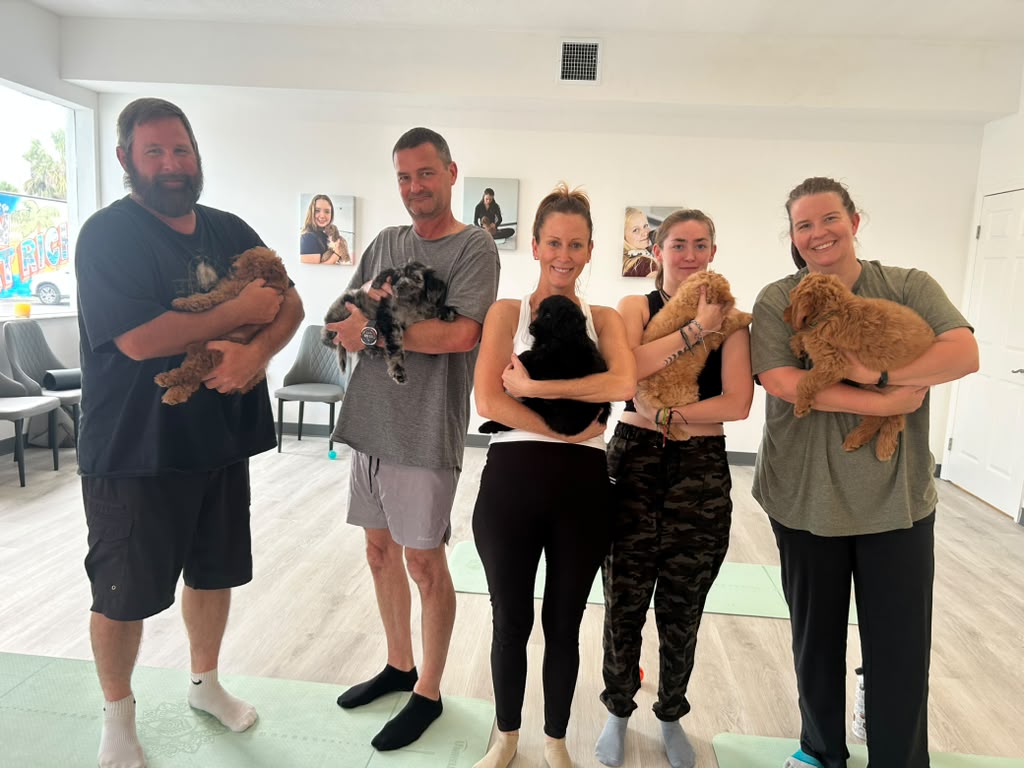
So what does a Pawsitively Pilates class actually feel like from start to finish? Picture this: you roll out your mat, soft music fills the room, and before you even finish settling in, a tiny puppy is already sniffing your shoelaces. That is the energy from the very first moment.
The class follows a structured arc that any Pilates instructor would recognize. You begin with gentle breathwork and a warm-up that eases your spine into movement, waking up the deep postural muscles before anything more demanding kicks in. From there, the session moves into core-focused mat sequences, think controlled movements like pelvic tilts, leg circles, and single-leg stretches that build stability from the inside out. The second half shifts into full body conditioning, engaging your glutes, back, arms, and legs through progressive exercises before winding down with a cooldown and full-body stretch. The puppies are present and roaming freely through every single phase, which makes even the more challenging moments feel genuinely fun rather than like hard work.
The environment is designed to feel welcoming rather than performative. There is no mirror wall silently judging your form, no competitive energy, and absolutely no pressure to keep up. The puppy element works almost like a social lubricant; when a fluffy distraction wanders into your personal space mid-exercise, everyone laughs, and that moment of shared joy instantly dissolves the awkwardness that often makes group fitness feel intimidating. According to instructors in the puppy Pilates space, this is a feature, not an accident.
The puppies also enhance specific exercises in surprisingly tangible ways. When you hold a supine bridge or sink into a rest pose, a warm puppy settling near you converts a standard recovery moment into something that genuinely melts tension from your body. Research consistently links human-animal interaction to reduced cortisol levels, so those puppy cuddles between sets are actively contributing to your stress relief, not just adding cuteness.
If you have never tried Pilates before, here is what to know before your first class: no prior experience is needed, every movement can be modified to suit your body, and the self-consciousness that typically keeps beginners on the sidelines gets quietly handled by the animals in the room. It is very hard to feel awkward when a puppy is trying to climb into your lap.
The bigger picture is that one Pawsitively Pilates session stacks multiple wellness benefits into a single booking: a genuine full body workout, mindfulness through breathwork, documented stress relief from puppy therapy, and real social connection with the people on the mats around you. That multi-benefit model is exactly what 2026 fitness consumers are actively looking for, and it is the sweet spot Pawsitively Pilates is built to fill.
The Unexpected Reason You Will Actually Stick With This Workout
Here is something that most fitness advice never tells you: the workout you actually show up for consistently will always beat the "perfect" workout you abandon after three weeks.
In 2026, community has been identified as one of three headline forces reshaping the wellness industry, sitting alongside movement and regeneration as a core pillar of what makes fitness work long-term (FitnessMarkt, 2026). This is not a soft, feel-good observation. Research tracking new gym members over a full year found that social motives and the quality of the shared experience were significant predictors of whether beginners stayed or dropped out. Shared experience is not a bonus feature of a good fitness class; it is often the deciding factor.
This is exactly where the puppy element does something no amount of instructor motivation can fully replicate. When a tiny puppy wanders across someone's mat mid-Hundred, the entire room laughs together. That moment of collective delight creates an immediate, genuine social bond between strangers that would normally take weeks of awkward small talk to develop. For beginners, who often cite feeling out of place as a reason they avoid group fitness classes altogether, that shared laughter is genuinely disarming. Studies exploring adherence among novice and veteran trainees consistently show that quality-of-life factors tied to the social experience of training separate those who stick with it from those who do not.
The practical implication is straightforward. Research from University College London found that habit formation takes an average of 66 days, not the commonly cited 21. That means consistency over roughly ten weeks is what converts a new workout into automatic behavior, and automatic behavior is what eventually produces visible changes in strength, posture, and body composition. Joyful workouts are not a nice extra; they are the mechanism that keeps you coming back long enough for the physical results to actually appear.
Contrast this with the typical gym experience for beginners. Studies show that around 80% of people abandon their fitness goals by February, often within the first 45 to 60 days of starting. The most common failure modes are not lack of effort; they are isolation, monotony, and the absence of any near-term reward that makes showing up feel worth it before the mirror starts reflecting change. When exercise feels like something to look forward to rather than a chore to push through, attendance becomes far less dependent on willpower, which is a finite and unreliable resource. A class with puppies, laughter, and community removes most of the friction that makes beginners quit before the results ever have a chance to show up.
Who Gets the Most Out of a Full Body Pilates Workout
The honest answer is: almost everyone. But there are certain people for whom a full body Pilates workout is not just a good option, it is genuinely the best option available right now.
1. Complete beginners with no fitness background
If you have never followed a structured workout routine in your life, Pilates is one of the most forgiving and effective places to start. The method builds foundational strength, stability, and body awareness from the ground up, without requiring any prior athletic experience. Cleveland Clinic notes that Pilates is fully customizable regardless of age, fitness level, or health status, and it actively helps correct the muscular imbalances most people develop from sitting at desks or moving on autopilot for years. You do not need to arrive knowing anything. That is the whole point.
2. People recovering from burnout or stress
Pilates moves at a measured, intentional pace that allows your mind and body to work together rather than compete. For anyone whose nervous system is running on empty from a demanding job or difficult season of life, the combination of controlled breathwork and gentle movement offers real relief. Layer in the documented mood-lifting effects of interacting with puppies during a Pawsitively Pilates class and you have a session that actively supports recovery, not just fitness.
3. Anyone bored by conventional gym workouts
Hybrid, experience-led formats are among the fastest-growing fitness categories in 2026. Pilates and Puppies sits right at the leading edge of that shift, blending core conditioning with genuine joy in a way that a standard treadmill session simply cannot replicate.
4. Animal lovers and wellness enthusiasts
For people who want their fitness to feel meaningful rather than mechanical, puppy interaction adds a layer of purpose and warmth that transforms a workout into an experience worth looking forward to every single week.
5. People of all ages and fitness levels
Pilates aligns directly with several of the ACSM's top 2026 fitness priorities, including balance and core strength at number five and fitness programs for older adults at number two. It is explicitly designed to be modified for different bodies, different ages, and different goals, making it one of the most genuinely inclusive full body workout formats available today.
Your Next Full Body Workout Should Feel This Good
Here is the bottom line: a full body workout does not have to hurt, confuse, or isolate you to work. Pilates has proven that low-impact movement delivers real, measurable conditioning across every major muscle group, and research confirms it reduces anxiety, stress, and depression at the same time. That is not a trade-off. That is a better deal.
What makes Pawsitively Pilates genuinely different is the layer nothing else offers. No other fitness format pairs deep core and full-body strengthening with the scientifically supported stress relief of puppy therapy. Lower cortisol, higher oxytocin, and a stronger body, all in one session. That combination simply does not exist anywhere else.
Your next step is simple: try a Pawsitively Pilates class. It is the lowest-barrier, highest-enjoyment entry point into a sustainable full body routine you will find.
And here is the reframe worth holding onto: the best workout is the one you actually show up for. When a class genuinely brings you joy, including tiny puppies wandering across your mat, consistency stops being a chore and starts taking care of itself.
Conclusion
Pilates truly is the full body workout that delivers without the burnout. It strengthens your core, improves flexibility, builds lean muscle, and leaves you feeling energized rather than destroyed. Whether you are a complete beginner or simply someone looking for a smarter way to move, Pilates meets you exactly where you are.
And if your dog decides to join your next session? Let them. Sometimes the best workout partners come with four legs and zero judgment.
Here is your next step: roll out your mat, try one of the beginner moves from this post, and commit to just ten minutes today. That is all it takes to start building a practice that actually sticks. Your body will thank you, your stress levels will drop, and who knows, your pup might just become your most dedicated workout buddy.
Start small. Stay consistent. Feel the difference.